
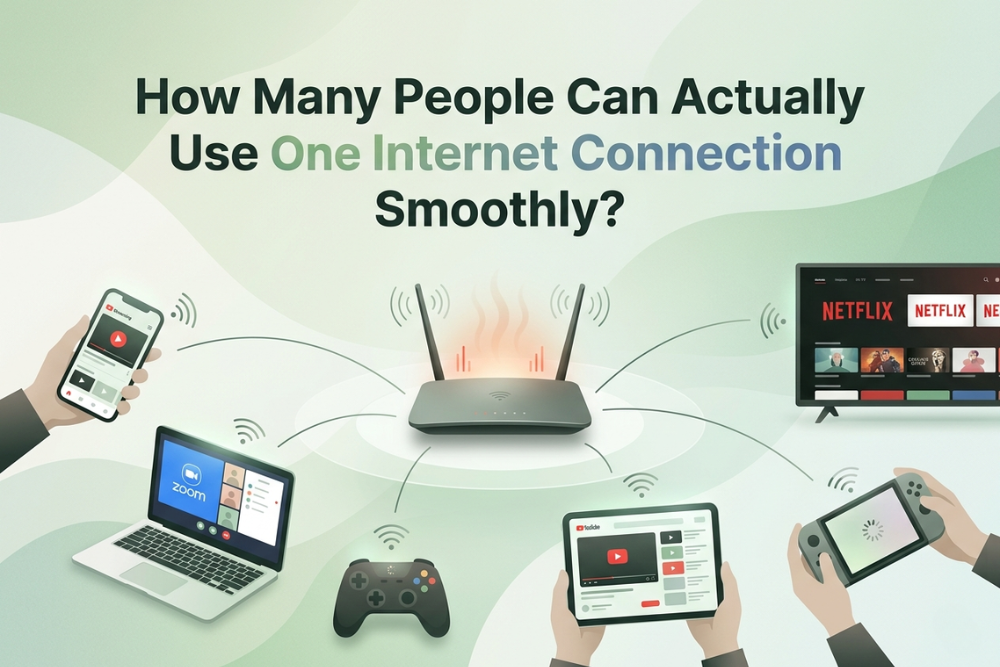
Many households and offices face the same situation every day. Netflix suddenly starts buffering, Zoom calls freeze in the middle of a conversation, and someone immediately asks whether the WiFi has slowed down. In most cases, people assume the issue is poor internet speed.
However, the real problem is often not the internet plan itself, but how many people and devices are using the connection at the same time. The more users sharing one network, the more pressure it puts on the available bandwidth.
Understanding What Smooth Internet Really Means
Smooth internet is not simply about having a high-speed plan. A connection is considered smooth when every user can browse, stream, and work online without interruptions or delays.
A reliable internet connection should provide:
- Buffer-free streaming while watching videos
- Stable video quality during meetings and calls
- Fast-loading websites and applications
- Consistent performance across multiple connected devices
The goal is not just speed on paper, but real-world performance that remains stable while everyone is online.
How Many Users Can One Internet Connection Support?
There is no universal number because internet capacity depends on speed, usage type, and the number of connected devices. A home where people casually browse social media will need far less bandwidth than a house where multiple users are streaming in 4K and attending video meetings.
Below is a practical estimate of how many people different internet speeds can support:
| Internet Speed | Ideal Number of Users | Suitable For |
|---|---|---|
| 30 Mbps | 2 to 3 users | Basic browsing, social media, HD YouTube |
| 50 Mbps | 3 to 5 users | Small families with moderate usage |
| 100 Mbps | 5 to 8 users | Streaming, work from home, online classes |
| 200 Mbps | 8 to 12 users | Large families, heavy daily internet use |
| 300 Mbps | 10 to 20 users | Offices, startups, shared workspaces |
| 500 Mbps+ | 20+ users | High-demand businesses and enterprise setups |
Choosing the right speed depends on your daily usage pattern rather than simply selecting the cheapest available plan.
Why Internet Slows Down When More People Connect
Internet bandwidth is shared among everyone using the same connection. As more users come online, the available speed gets divided across devices, which can reduce performance if the plan is not sufficient.
Several factors contribute to this slowdown:
- Bandwidth sharing: Every active user consumes part of the available speed
- Device overload: Smartphones, smart TVs, laptops, cameras, and IoT devices all use bandwidth
- Router limitations: Some routers struggle to manage too many simultaneous connections
This is why even a decent internet plan can feel slow when too many people are connected at once.
Building a Better Setup for Multiple Users
Managing multiple users smoothly is not always about purchasing the fastest plan. In many cases, the right setup can improve performance significantly without unnecessary upgrades.
A few practical ways to improve network performance include:
- Upgrading to fiber broadband for more stable speeds
- Using a dual-band router to distribute traffic efficiently
- Reducing heavy downloads during meetings or peak hours
- Connecting important work devices through LAN for better stability
A properly optimized setup ensures better performance across all users and devices.
Why Fiber Broadband Makes a Big Difference
Traditional broadband often struggles when multiple users access the network together, especially during busy hours. Fiber broadband offers better consistency because it can maintain speed more effectively even under heavy load.
Fiber broadband provides several advantages:
- Stable speed throughout the day
- Better handling of multiple users and devices
- Lower latency for gaming and video calls
- Faster upload and download performance
For families and businesses in Bhubaneswar, fiber has become the preferred option because of its long-term reliability.
Why This Is Especially Important for Modern Homes
Internet demand has increased significantly in recent years. A typical household in Bhubaneswar may now have several smartphones, laptops, a smart TV, and additional connected devices all running at once.
Many homes today regularly manage:
- 3 to 5 smartphones
- 1 to 2 laptops
- Smart TVs
- Security cameras and smart home devices
This means even a standard family can easily have 8 to 10 devices connected simultaneously. Without the right plan and setup, performance issues become unavoidable.
Choosing Internet That Matches Your Lifestyle
The most important question is no longer how fast your internet is on paper. The real question is whether your connection can handle your household or office’s actual usage demands.
Modern internet connections are no longer built for a single user. They are expected to support families, remote workers, students, and businesses all at the same time. Selecting the right broadband setup requires understanding both speed requirements and user behavior.
Experience Reliable Multi-User Internet with JetSpot
If your current connection struggles whenever multiple people go online, it may be time to switch to a broadband provider built for modern usage. JetSpot offers high-speed fiber broadband in Bhubaneswar designed to support homes and offices with multiple active users, connected devices, and heavy daily internet demands. Whether you need internet for a small family or a busy workplace, JetSpot delivers the stable and reliable performance required for uninterrupted connectivity. Contact JetSpot today to upgrade to a smarter broadband experience.